
StingRay: Marketing Strategy for an EV Charging Service Provider
This project involved analyzing the market, competitive landscape, and strategic direction for StingRay, a new Electric Vehicle (EV) charging point service provider in the UK. StingRay’s mission is to connect EV drivers with charging point hosts.
The analysis culminated in a comprehensive marketing strategy proposal, focusing on digital channels, customer segmentation, and product positioning to achieve the company’s ambitious growth objectives
Key Objectives and Scope of Work
The primary goal of StingRay is to enable 7,500 home charging stations throughout England and Scotland and gain 50,000 EV users by December 2026.
The project involved the following analytical components:
- Market Analysis (PESTEL & Porter’s 5 Forces): Evaluating the external business environment, including UK government grants for EV infrastructure and competitive forces like high rivalry from established players.
- Customer Identification: Defining StingRay’s B2C customers (Homeowners, Renters/Flat Owners, EV Drivers) and B2B customers (Landlords).
- Competitive Evaluation: Assessing main UK competitors (Easee, Hypervolt, Wallbox) on price, installation, and problem-solving, identifying a key challenge for StingRay in those areas.
- Strategic Planning (SMART & SWOT): Evaluating the feasibility of the goals and identifying Strengths (cutting-edge technology), Weaknesses (brand recognition), Opportunities (market growth), and Threats (intense competition, economic recession).
Strategic Positioning and Segmentation
StingRay Business Positioning Map
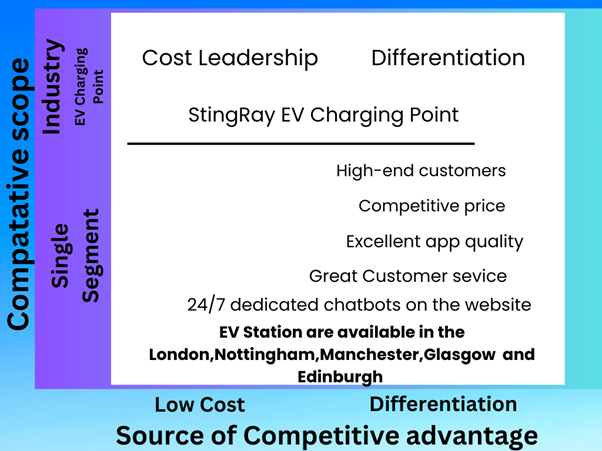
StingRay is positioned for differentiation in a single segment (high-end customers). The competitive advantages are based on:
- Competitive pricing
- Excellent app quality for reservations and usage tracking
- Great customer service, including 24/7 dedicated chatbots
- Availability in five major UK cities (London, Manchester, Nottingham, Edinburgh, Glasgow)
Target Customer Segments
- Geographic: Targeting London, Manchester, Nottingham, Edinburgh, and Glasgow, prioritizing areas with high EV driver concentration (Manchester, London, Nottingham).
- Demographic: Focusing on the 35+ age group for both genders, recognizing their financial stability as an opportunity.
- Psychographic: Targeting individuals motivated by sustainability, eco-friendly values, and seeking new innovations and convenient service.
Marketing Mix (4 P’s) and Digital Recommendations
Product
- The offering is connecting EV drivers with home charging hosts.
- It provides EV owners with a home-charging solution offering rapid speeds and reducing reliance on public charging.
- Future product plans include a premium subscription tier on the app for reserving charging spots using loyalty points.
- Recommendation: Focus on providing better service than competitors in high-speed charging and 24-hour problem-solving.
Price
- Recommendation: Implement a price skimming strategy initially due to the startup nature and high-end market target. This generates high initial revenue and allows for price adjustments later (e.g., early 2026) to attract more clients.
Place (Distribution/Digital Platform)
- The central “place” is the website and mobile app.
- Website/App Recommendations:
- Ensure excellent User Experience (UX), high speed (under three seconds load time), and mobile-friendliness.
- Include clear Call-To-Action (CTA) buttons and effective use of pop-ups/banners to capture leads and boost subscriptions.
- Feature customer reviews to build trust.
Promotion
- Social Media Marketing (SMM):
- Facebook (B2C & B2B): Best platform to target the 35+ age group. Recommended posting frequency is at least three times weekly to increase engagement and brand awareness.
- LinkedIn (B2B): Focus on connecting with potential hosts (B2B customers).
- Email Marketing: Recommended for lead generation and brand awareness, utilising email automation to segment customers based on demographics and behaviour.
- Search Engine Optimisation (SEO): Identified as the main long-term marketing investment to increase organic traffic, build audience trust, and achieve higher conversion rates.
- Additional Tools: Use Google Analytics to track website visitor behavior for targeted advertising and improving personas. Invest in Video Marketing (e.g., YouTube) as a primary way to attract customers.